


by Dr. Michael Bindon
When I eventually came face to face with concept-based learning, working as a curriculum manager at the IB more than a decade after my initial teacher training, my first reaction wasn't enlightenment. It was a quiet, creeping suspicion that I had been doing things wrong.
The professional development I sat through talked about concepts, conceptual understandings, and transfer. It was compelling. It was rigorous. And almost none of it spoke to what I actually did as a theatre educator.
I've thought a lot about why that was. And I think the answer is this: nearly all concept-based professional learning is built around what Erickson and Lanning call the Structure of Knowledge. Understanding that emerges from the close study of facts, topics, and texts. You analyse a play, you uncover ideas, you articulate what the material reveals. That's one valid way to learn.
But theatre teaching isn't primarily like that.
Where the mismatch happens
The majority of concept-based approaches assume that understanding begins with something to study. A text. A case. A body of knowledge that can be examined, discussed, and gradually generalised into broader conceptual understanding.
That works in many subjects.
But in a theatre classroom, understanding doesn't begin there. It begins in the act of making. In rehearsal rooms, on the floor, in the moment something shifts and suddenly works. A student doesn't arrive at an idea about power or identity because they have analysed a scene in detail. They arrive at it because they have staged that scene in three different ways and realised that each choice changes what the audience understands.
That kind of learning isn't derived from analysis after the fact. It emerges through action.
And that is what Erickson and Lanning describe as the Structure of Process. The majority of what we do in theatre lives there. In devising, performing, experimenting, and collaborating. The most important concepts in a theatre classroom aren't drawn from assigned texts. They emerge from the skills, strategies, and processes students are actively engaged in.

The language I was missing
This distinction between Structure of Knowledge and Structure of Process is one of the most clarifying ideas I've encountered in curriculum thinking. And it took me far too long to find it.
Because the concept-based professional development I attended never made it explicit. The frameworks assumed a knowledge-heavy starting point. Arts teachers were, as is so often the case, an afterthought (at best), left to retrofit ideas that were never designed with us in mind, wondering why the fit felt so forced.
It was working with the brilliant Nyssa Brown, a certified Erickson and Lanning Concept-Based Curriculum and Instruction trainer who has spent her career at the intersection of arts education and curriculum design, that finally gave me the language I had been missing.
The concepts that matter most in theatre aren't the ones you extract from studying a practitioner. They are the ones that surface in the middle of the work. When a student asks why their staging choice worked. When they notice how a shift in physicality changes meaning. When they begin to understand how an audience reads what they create.
Those are Structure of Process questions. And they deserve Structure of Process answers.
What shifts when you see it
If you've ever sat in a whole-school PD session on concept-based learning and thought, "this doesn't quite fit what I do," you weren't wrong.
The framework itself is sound. It is powerful, rigorous, and worth holding onto.
But it has too often been applied as though all learning begins in the same place. As though understanding must be extracted from something studied, rather than generated through something made.
Once you see the distinction, the tension starts to fall away. Planning becomes clearer. Assessment becomes more authentic. And students begin to articulate understanding that is grounded in what they have actually experienced, not just what they have analysed.
Concept-based PD, built for theatre teachers
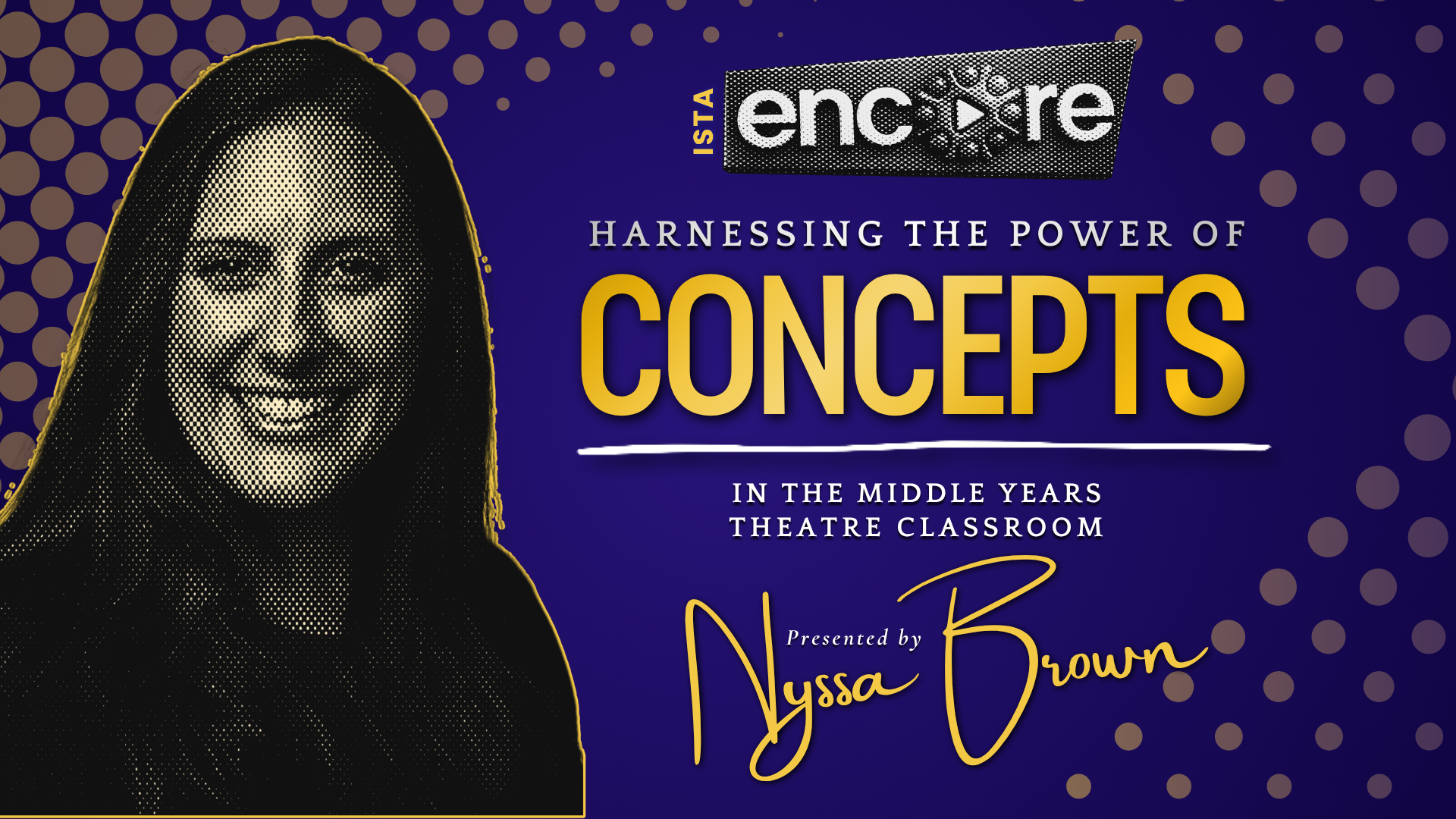
Harnessing the Power of Concepts in the Middle Years Theatre Classroom is a new on-demand course for ISTA Encore, presented by Nyssa Brown.
Inside the course, you’ll explore how to move beyond activity-driven units so that learning transfers across performances and over time. You’ll develop conceptual understandings and questions that genuinely guide both planning and assessment, rather than sitting alongside them. The course also focuses on building the language needed to clearly articulate the value of theatre learning to curriculum leaders, alongside real case studies from practising theatre teachers working in schools.
Launching in 2026. Pre-order now: https://encore.istaglobal.org/courses/concept-based-theatre
References and further reading
Erickson, H.L., Lanning, L.A., and French, R. (2017). Concept-Based Curriculum and Instruction for the Thinking Classroom (2nd ed.). Corwin Press.
Erickson, H.L. (2007). Stirring the Head, Heart, and Soul: Redefining Curriculum, Instruction, and Concept-Based Learning (3rd ed.). Corwin Press.
International Baccalaureate Organization (2014). MYP: From Principles into Practice. IBO.
Aristidou, D. (Ed.) (2020). Adventures in Theatre: The ISTA Method. ISTA Publications.
Brown, N. (2025). Harnessing the Power of Concepts in Middle Years Theatre. ISTA Encore. encore.istaglobal.org/courses/concept-based-theatre


