


| By Mike Bindon |
One of the most persistent assumptions in international schools is that Group 6 in the IB Diploma Programme must be presented to students as an optional subject group.
In reality, it does not.
The IB framework allows schools significant flexibility in how the arts are positioned within their programmes. Schools are able to require students to take an arts subject if they wish. Yet in many international schools, the message passed to students is that the arts are simply an optional extra.
Why does this happen?
One possible explanation lies in the concept of mimetic isomorphism, a key idea from institutional theory. First described by DiMaggio and Powell (1983), mimetic isomorphism refers to the tendency of organisations to imitate the structures, strategies or practices of other organisations that appear successful, particularly during periods of uncertainty. In complex or ambiguous environments, copying peers can feel like a safe and rational strategy for gaining legitimacy.
International schools are not immune to this dynamic.
Policies and structures are often inherited from other schools, replicated through recruitment networks or passed along informally through professional conversations. Over time, these practices become normalised, creating the impression that certain structures are fixed requirements rather than choices.
The positioning of the arts in many schools may be one such example.
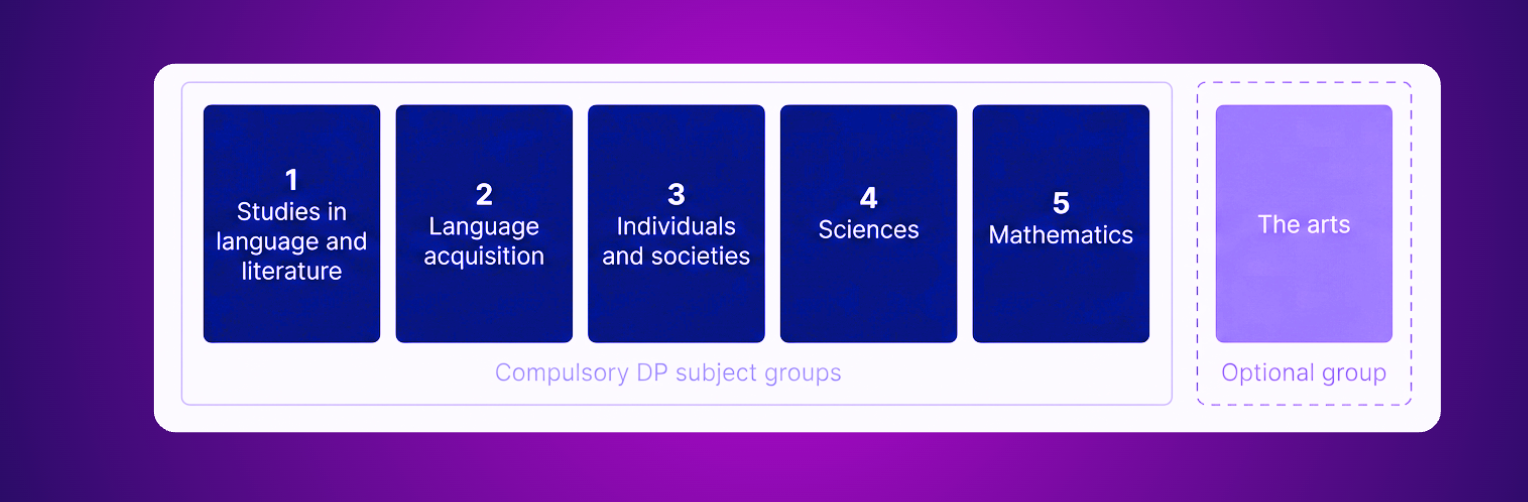
Group 6 allows students to choose an arts subject, but it does not require schools to frame the arts as optional within their offering. Rather, it is a mechanism of flexibility that enables schools to determine how the arts are positioned within their programmes.
Indeed, the IB itself is explicit that “the arts are fundamental to developing the values at the heart of an IB education” (International Baccalaureate Organization, 2026).
Yet in practice, many schools replicate the same approach: the arts become the optional group, often functioning as a catch-all curricular space that facilitates the selection of other subjects presented alongside the arts as second subject specialisms. Within this structure, the arts can become positioned as less credible, less valuable and less necessary than other areas of the curriculum.
At the same time, the international school landscape is evolving. While the global sector continues to grow, the number of international schools has expanded significantly, creating increasing competition between schools for students and families. ISC Research estimates that there are now more than 15,000 international schools worldwide educating more than seven million students, with the market continuing to expand (ISC Research, 2025).
In this environment, simply replicating what neighbouring schools appear to be doing may not be the most strategic approach.
As competition increases and families have more choice, schools are increasingly required to articulate what makes them distinctive. The schools that stand out are often those that make intentional choices about their educational identity, rather than inheriting structures that were never consciously designed.
For me, the arts are one of the most powerful ways schools can express that identity.
- Arts programmes build culture.
- They shape the life and character of a school.
- They create visible community moments.
- They develop creativity, collaboration, empathy and confidence in ways that few other areas of the curriculum can replicate.
In short, the arts are culture-building subjects.
If a school decides that the arts should remain optional, that is a valid choice – particularly when it is grounded in deliberate community engagement and contextual factors. But it should be a conscious decision, made through consultation, with a clear understanding of the opportunities and pathways that may open or close as a result, and a thoughtful consideration of the implications.
It should never simply be a policy inherited from somewhere else, long before anyone currently working at the school arrived.
The future of international schools may depend less on copying what others have always done, and more on having the confidence to decide what truly matters in your own community.
And for many schools, the arts may be the key to unlocking that difference.
References
DiMaggio, P.J. and Powell, W.W., 1983. The iron cage revisited: Institutional isomorphism and collective rationality in organizational fields. American Sociological Review, 48(2), pp.147–160.
International Baccalaureate Organization, 2026. The arts. [online] Available at: https://www.ibo.org/programmes/diploma-programme/curriculum/the-arts/ [Accessed 12 Mar. 2026].
ISC Research, 2025. The international schools market in 2025. [online] Available at: https://iscresearch.com/the-international-schools-market-in-2025/ [Accessed 12 Mar. 2026].


