

By Ramesh Meyyappan (Scotland)
My career in theatre has spanned almost 30 years — as performer, teacher, actor, and director. For many years I have focused on developing my own visual theatrical vocabulary. This is an important aspect of my work — making it accessible to deaf and hearing while attempting to maintain artistic and creative ways to tell my stories. I have been fortunate in the opportunities I’ve had to create work and as such haven’t had to give much thought to how scripts are presented to/for the deaf. P ro l ed pract
‘Accessibility must be creative, not an afterthought.’
Being given opportunities to create work myself, I felt it important to script my ideas to share them with production teams and creative collaborators. I have begun to consider how, as a deaf person, I make scripts accessible to other deaf. This provides some background about me as a theatre-maker, processes I’ve used (scripted/ unscripted), and a little about what I’ve witnessed in terms of deaf engagement in theatre-making. Beginning my acting career in Singapore working with a mostly deaf (or signing) theatre company (Hi! Theatre), I rarely concerned myself with accessibility of scripts.
Like many deaf companies our work was entirely visual and usually devised. Our 1990s contemporaries worked much like us or devised work that dealt with deaf issues. Since then there has been progress, particularly in the number of deaf involved in theatre and associated arts, with increasing support and interest from mainstream theatre companies. Being deaf and being actively involved in theatre both nationally and internationally, I’ve been fortunate to be involved in a range of processes making efforts to create work for/by deaf ice performers.
I have witnessed how others have attempted to evolve their work to make it more generally accessible. As a theatre-maker I develop performances using an eclectic mix of visual and physical styles. I continually seek to extend my visual vocabulary — incorporating circus techniques, bouffon, puppetry, and illusion — while creating strong narrative work. Since moving to Scotland, I have played an important role in raising awareness of deafness in the Scottish theatre community.
I work tirelessly at making my work mainstream, accessible both to deaf and hearing. I was involved in the programme design team for the BA Performance in British Sign Language (BSL) and English at the Royal Conservatoire of Scotland where I taught the visual theatre module. I continue to create accessible theatre work that successfully tours nationally and internationally. I was nominated five times for best actor at the Life! Theatre Awards (Singapore), winning twice. In Scotland I was nominated for a Total Theatre Award for Snails & Ketchup and for best male performance (2017) at the Critics’ Awards for Theatre in Scotland for Off Kilter. Off Kilter was showcased at Edinburgh Fringe Festival, Milan, Paris, Vienna, Reims, and Shanghai.
Early life
Born in a small rural village in Southern India, my parents decided to move to Singapore in the hope that both my sister and I, being deaf, got access to education catering to our ‘condition’ and greater opportunities. A tough decision as they had to leave my older brother in India. My household was interesting to observe and difficult to describe. Neither of my parents spoke or used English — only Tamil — nor signed. My sister was multilingual.
I know very little Tamil, my f irst language is American Sign Language (ASL), and I use English. We are a visual family and the chat would do a round, with some translation or working out to do at times. This is perhaps why a visual language became important to me — linguistics and semantics were less relevant as they didn’t help with our communication.
Singapore and early arts career
Initially I was very content working in Singapore, excited by the idea that we had a growing arts scene and always eager to be part of the development of the arts there. I was finding my feet in terms of having a sense of what I wanted to do, had just become artistic director of Hi! Theatre, and felt I had done a decent job adapting and directing Macbeth into a piece of visual theatre. This was a milestone for me in terms of becoming aware of visual possibilities when adapting texts. However, being aware of the possibilities, I felt I wanted to explore more and applied to Liverpool Institute for Performing Arts (LIPA) who afforded me the opportunity.
I was the first deaf student at LIPA as well as being the first deaf recipient of a Shell–National Arts Council scholarship allowing me to study overseas. I graduated from LIPA with a first class BA Honours in Performing Arts and also received the Philip Holt Trust award the same year. While at LIPA I was selected to perform at the National Student Drama Festival with a solo performance I developed — my adaptation of Dario Fo’s Mistero Buffo. There was much interest in my work as I was the first deaf to perform at such a festival. Being in Liverpool was more than just a time of study,
I genuinely saw the potential of developing visual theatre work combining a range of disciplines, developing my own solo work, and collaborating with individuals and companies such as Spike Theatre, Unity Theatre (who often programmed my work), and Hope Street Theatre. This was very much a springboard. Mistero Buffo and subsequent solo performances (This Side Up and The Tell-Tale Heart) saw me touring extensively for a few years — Singapore, Edinburgh Festival, France (Paris, Reims), USA (Washington, Baltimore), Austria, Sweden, Norway, Iceland, Australia, New Zealand, England, Poland, Cambodia, Hong Kong, and India. The work was entirely visual and therefore had universal/international appeal. At this point I was committed to demonstrating the possibilities of a shared language — that deaf shouldn’t be insular in their approaches to work (much work created by deaf was primarily for deaf/ signing audiences). To this extent I was seen by some as a pioneer — demonstrating the possibilities of work with/by deaf, and that it could and should be seen/presented on mainstream stages. This was important not just to me but also to the wider deaf community.
As a deaf person, I had gained critical recognition — reviews talked about my craft and rarely mentioned my deafness (I was never the token deaf), my work spoke for itself and even earned a few nominations and awards. My commitment and passion for creating accessible work garnered interest and invitations to share my work through talks at conferences, workshops, and masterclasses, directing for and collaborating with individuals and theatre companies. In Scotland I’ve had opportunities to collaborate with individuals and companies — all have been keen to explore visual possibilities when creating theatre and have supported my aim to develop a visual theatre vocabulary unique to each piece of work. For Snails & Ketchup (Unlimited commission) and Skewered Snails (second Unlimited commission) I combined aerial work and choreography with strong characterisation (playing and transitioning between multiple roles). Butterfly made use of puppetry and choreography to re-tell a version of Nabokov’s Madame Butterfly. Off Kilter made use of illusion/magic in a dark comedy that deals with mental health/well-being.
‘Visual theatre can be a shared language.’
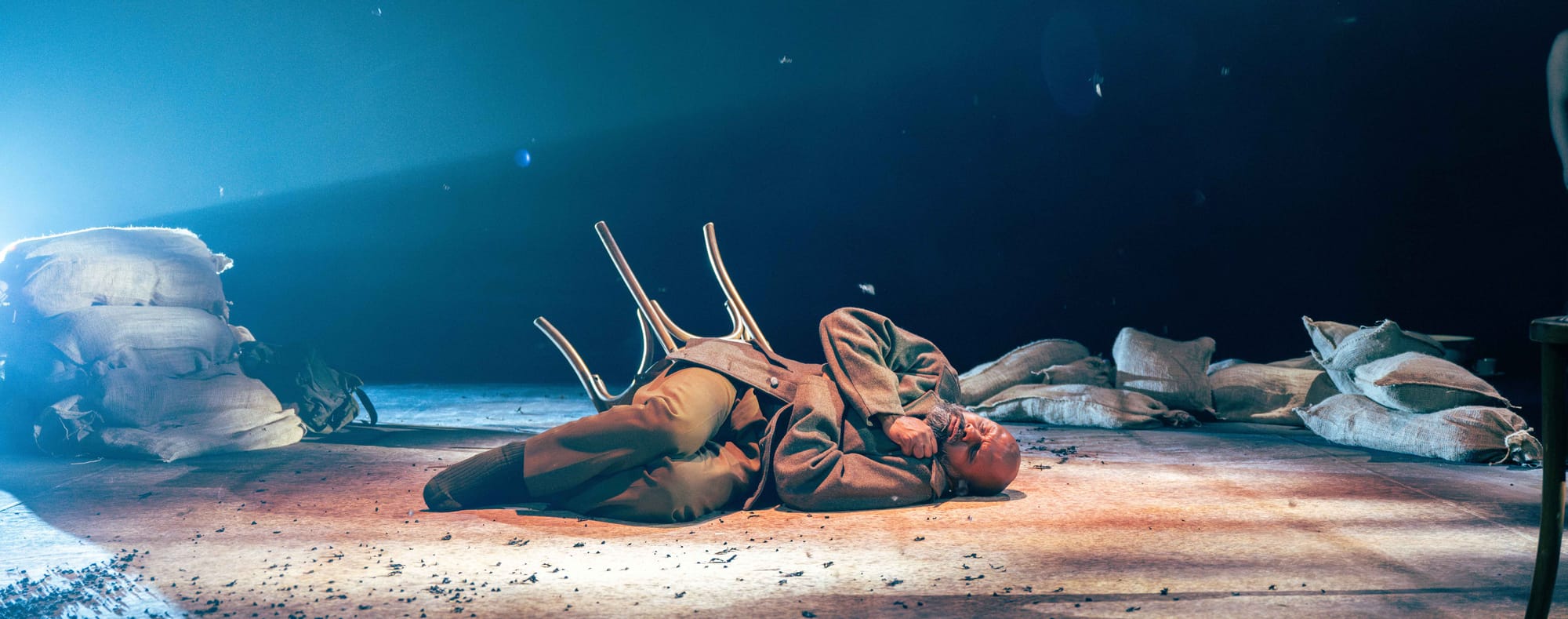
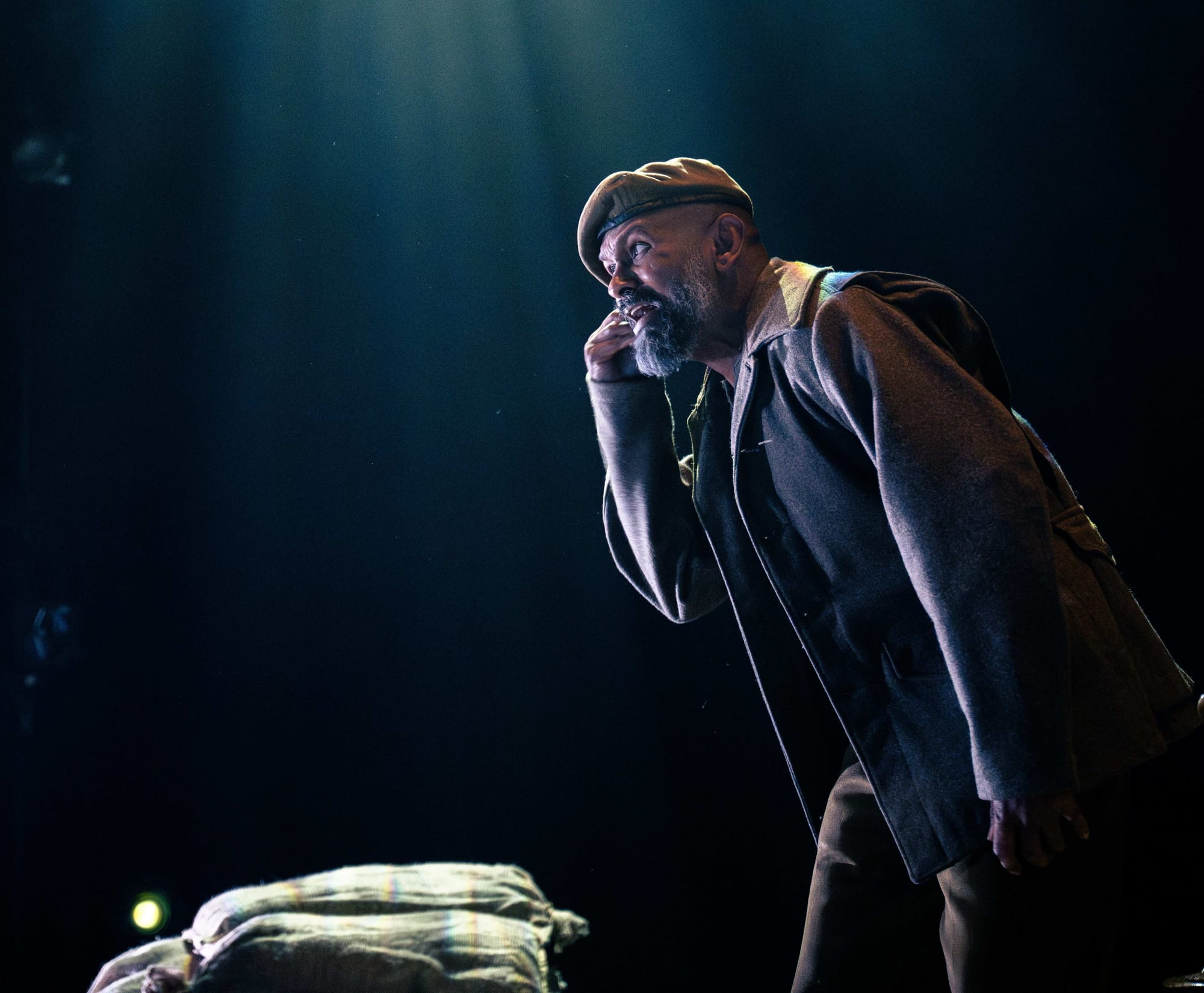
More recently, working with Raw Material as producers I have extended my collaborations to work with National Theatre of Scotland, Tron Theatre, and Vanishing Point on some visually successful productions like Love Beyond and Lear — my adaptation of King Lear as a commission from Singapore International Festival of Arts with support from Creative Scotland and National Theatre of Scotland. I aim to continue to focus on creating work, collaborating with like-minded individuals to explore the many visual possibilities within a theatrical vocabulary and to find ways to script for future deaf and hearing to maybe consider themselves.


