


| By Dr Penny Hay, Professor of Imagination, Bath Spa University |
As Professor of Imagination (a very Harry Potter title), I am determined to place imagination and creativity at the heart of all learning. Imagine if these creative learning dispositions were central to our education systems. Imagine if all learning was transdisciplinary and intergenerational - imaginative and beautiful learning that prioritises the arts. Of course, imagination and creativity are in every subject, not just the arts, but what the arts do so well is shine a light on these habits of mind and how important they are in our lives. The arts and aesthetic education are vital to our ways of knowing and being in the world, as sense-making, making meaning.
‘Access to a broad range of artistic and cultural expressions is fundamental to realise the human right to participate in cultural life, which is an enabling condition for individual and societal well-being.’ (UNESCO 2024)
So how do we integrate imaginative learning and teaching in our daily work, in and through the arts? As educators and artists and as role models, we can invite imaginative, creative, and playful pedagogies by manifesting these habits of mind each day. Cultivating the conditions for curiosity, imagination, and creativity is vital in nurturing these life long dispositions in our students and colleagues – to develop learners who are curious, creative, and confident to learn imaginatively alongside others in the community.
My dear friend and mentor, the late Sir Ken Robinson, described curiosity as the engine of achievement (Robinson 2013) - to be human is to be creative, to be compelled to engage with and make sense of the world around us. Sir Ken talked often about creativity as imagination and purpose, making connections and seeing relationships, and envisaging what might be.
‘Imagination is the capacity to bring into mind things that are not present, it's a very powerful and unique set of capacities that human beings have. We use all our senses, and our shared and unique capacities, to find meaning and communicate with others. Creativity is putting in the imagination to work.’ (Robinson 2015)
As creative educators we have a shared purpose to offer an alternative, creative approach to learning and teaching. In our partnership work with Bath Spa University and House of Imagination, our signature projects are School Without Walls with the Egg Theatre (Hay 2022) and Forest of Imagination with Grant Associates and Feilden Clegg Bradley Studios (Hay 2024). Together with artists, educators, and cultural partners we are researching experimental sites for pedagogical innovation. We are making creativity and imagination visible, placing emphasis on social value, social impact and the importance of social and environmental justice. Our creative methodology, ‘everyone is an artist’, drives our ambition for artistic excellence.
‘Art has the power to be transformational in our lives, and we all have the potential to be artists.’ (Hay 2023)
We engage students, educators, artists, and creative professionals in creative and reflective practice that places curiosity, creativity, and confidence at the heart of a creative and reflective pedagogy. These spaces of possibility can be interrogated to distil a repertoire of creative pedagogical characteristics that optimise imagination, agency, freedom, and choice.
As artists and educators, we can actively value the concept of playful and imaginative learning, using our collective imagination and creativity to seek solutions to complex problems and contexts. These spaces of possibility and dialogue open up our imaginative learning potential as co-learners. Prioritising curiosity, imagination, and creativity encourages us all to explore, experiment and reflect through trans-disciplinary experiences, and provides opportunities for active, embodied, sensory learning and engagement. Through sensory experience our imagination is playful; manifesting creative possibilities.
‘Creative pedagogies exist at the intersection of the art and science of teaching and they can be used in an education context to teach learners how to learn creatively, problem-solve, take risks and to become creators of themselves and their future.’ (Cremin and Chappell 2021).
Developing curiosity and professional creativity develops confidence in both learning and teaching in collaboration, and is enhanced through supportive learning communities. Thinking about the conditions for cultivating creativity, we can create opportunities for developing learner agency to develop imaginative and creative skills for both individual and collaborative learning. By placing value on this space of pedagogic emergence and possibility, we also co-create inquiry and learning in an intra-disciplinary space. Noticing and witnessing students’ engagement is vital in this process – how they are listening, exploring, inventing, taking risks, being playful and curious, solving problems, making connections, communicating ideas and constructing meaning?
Tim Ingold (2010) talks of creativity as a process that ‘feeds forward’ as generative and improvisational, valuing the space of uncertainty and not knowing as a space of possibility for co-creation. We need to co-create learning spaces that are inspirational, open, and inclusive to invite learning that is joyful, complex, and full of delight.
‘Encountering the new and being taken beyond constitutes precisely what is essential to their self-formation. In this sense, art as alterity is more important for students who are still becoming, so they can be ever renewed and transformed, and that is the beauty and hope of education.’ (Zhao 2014)
Engaging our collective imagination through creative and embodied practices invites the transformational power of the arts for radical change. Creative and reflective practice is living in a permanent state of research to inform pedagogical innovation, to be aware, and to understand experience itself. Research-creation and arts-based research, theory, and practice are interrelated, prioritising philosophical thinking as a creative and pedagogical practice – how we are being, thinking, seeing, relating, collaborating, and acting in the world.
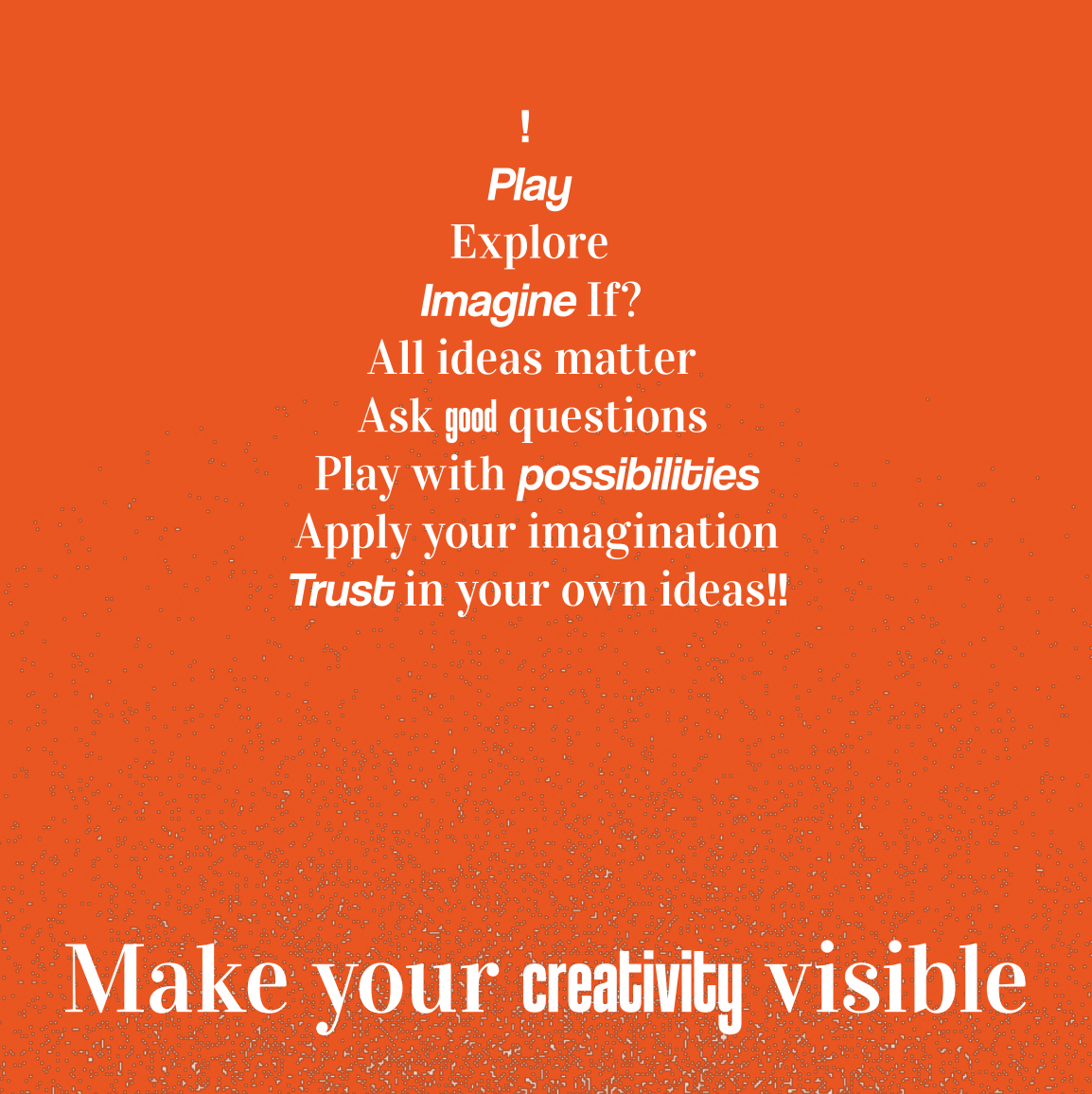
To close, I will offer you a playful approach to use in your own context as artists and educators, and to invent pedagogical approaches to collective experimentation, imagination, and creativity.
References
Cremin, T., & Chappell, K.. Creative pedagogies: a systematic review. Research Papers in Education, 2021, 36:3, 299-331.
Hay, P. School Without Walls. Education 3-13 International Journal of Primary, Elementary and Early Years Education. Volume 50, 2022, pp 521-535.
Hay, Penny. 2023. Children Are Artists: Supporting Children’s Learning Identity as Artists. Taylor & Francis.
Hay, P. 2024. Creative Pedagogies: School Without Walls and Forest of Imagination. International Journal of Art and Design Education. Volume 43, Special Issue.
Ingold, T. 2010 Working Paper #15 Bringing Things to Life: Creative Entanglements in a World of Materials. University of Aberdeen.
Robinson, K. 2013 www.ted.com/talks/sir_ken_robinson_how_to_escape_education's_death_valley?
Robinson, K. 2015. Creative Revolution: Keynote speech at Bath Spa University.
Zhao, G. 2014. Art as Alterity in Education. Published in: Educational Theory, v. 64 no. 3, pp. 245-259.
UNESCO. 2024. Framework for Culture and Arts Education.
Dr Penny Hay is an artist, educator and researcher, Professor of Imagination at the Centre for Cultural and Creative Industries, Reader in Creative Teaching and Learning at Bath Spa University, and Founding Director of House of Imagination. Her signature projects include School Without Walls and Forest of Imagination. Penny’s doctoral research focused on children’s learning identities as artists.
Penny is strand leader for Creative Pedagogy in the Policy, Pedagogy and Practice Research Centre, and co-chair of the eARTh research group, which focuses on education, arts and the environment. She was recently co-investigator on Interstice, an Erasmus+ project in Europe researching the space between art, children and educators, and an artist-researcher on the AHRC-funded Rethinking Waste Compound13 project in Mumbai.
Penny was awarded an Honorary Fellowship at Arts University Plymouth and a Fellowship in Imagination at the Centre for Future Thinking. She is a National Teaching Fellow and a Fellow of the Chartered College of Teaching.
